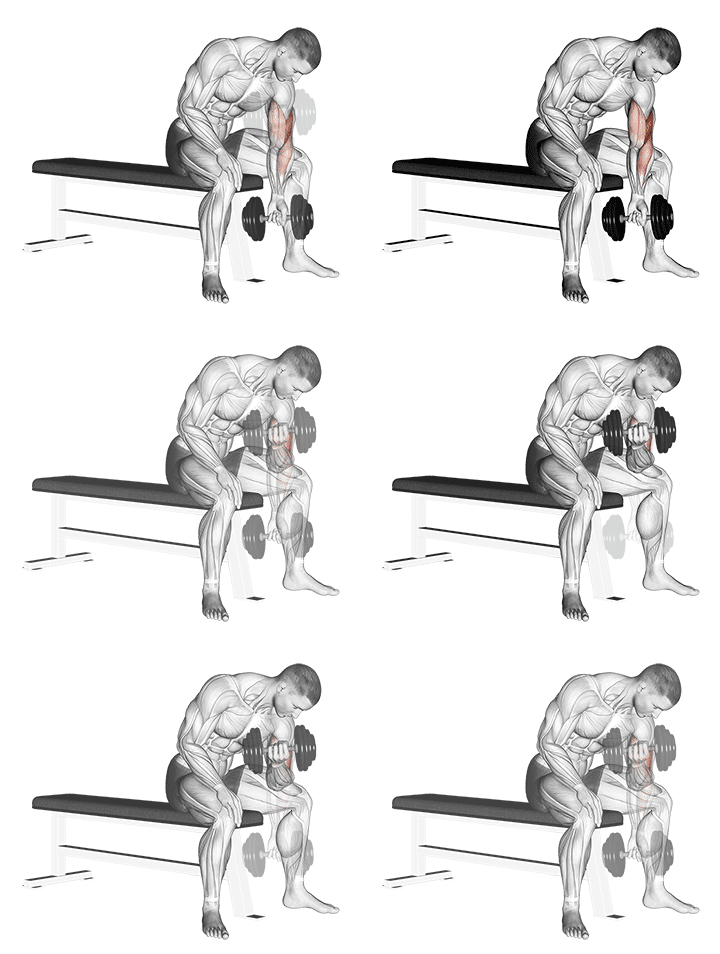
Target Muscle Group:
Biceps
Equipment Required
Dumbbell & a bench
Experience Level:
Beginner
Secondary Muscles
Forearm, Triceps
Ideal sets & reps:
4 sets of 10 reps
Benefits
- 1. Concentration curls promote strict control, minimizing the risk of injury and ensuring maximum muscle activation.
- 2. Concentration curls focus on the biceps by eliminating cheating movements, helping develop their size, strength, and definition.
- 3. By working the biceps through a full range of motion, concentration curls enhance the shape and separation of muscle fibers, improving definition.
- 4. Concentration curls strengthen the connection between the mind and muscles, optimizing muscle activation and growth.
- 5. Performing concentration curls individually on each arm helps address muscle imbalances and ensures balanced development.
Instructions
- 1. Sit on a bench or chair with your feet flat on the floor and your knees slightly apart.
- 2. Hold a dumbbell in one hand, palm facing up, and let your arm hang down between your legs. Your elbow should be slightly bent.
- 3. Rest the back of your upper arm against the inside of your thigh, just above the knee. Your forearm should be extended, and the dumbbell should be hanging down.
- 4. Keeping your upper arm stationary, exhale and curl the dumbbell up towards your shoulder while contracting your bicep. Keep your palm facing up throughout the movement.
- 5. Pause for a moment at the top of the curl, squeezing your bicep. In a controlled manner, slowly lower the dumbbell back to the starting position while inhaling. Repeat for the desired number of repetitions, then switch arms and repeat the exercise with the other arm.
Points to remember
- 1. Keep your core muscles engaged throughout the exercise to maintain stability and proper posture.
- 2. Sit upright on a bench or chair, keeping your back straight and feet flat on the floor. Avoid slouching or hunching over during the exercise.
- 3. Rest the back of your upper arm against the inside of your thigh, just above the knee. This helps isolate the biceps and prevents excessive swinging or momentum.
- 4. Concentrate on the muscles you are targeting (the biceps) and consciously contract them while during each repetition. This helps maximize muscle activation and results in a nice pump.
- 5. Perform the exercise in a slow and controlled manner, focusing on the contraction of the biceps during the curl and the controlled lowering of the weight back to the starting position. Avoid using momentum or jerking motions.
Popular Questions
- Q1. What do concentration curls work ?
- A1. Concentration curls primarily target the biceps brachii muscle, which is responsible for flexing the elbow joint and forearm supination. They also engage the brachialis muscle to a lesser extent, helping add thickness to the upper arm.
- Q2. Why are Concentration curls so hard ?
- A2. Concentration curls can be challenging due to their focused bicep isolation, limited momentum, and increased mental focus. They require strict form, control, and engagement of the biceps, making them harder than exercises involving multiple muscle groups or assistance.
- Q3. Which head do concentration curls work ?
- A3. Concentration curls primarily target the short head of the biceps brachii muscle. The exercise involves flexing the elbow joint while keeping the upper arm stationary, which emphasizes the contraction of the short head. However, the long head of the biceps also assists in the movement, though to a lesser extent.
- Q4. Are concentration curls and preacher curl the same ?
- A4. Concentration curls and preacher curls are similar biceps exercises, but they differ in technique. Concentration curls involve sitting and curling the weight with the arm against the inner thigh, while preacher curls are performed on a specialized bench with the arms resting on a pad, emphasizing the long head of the biceps.
- Q5. How many Concentration curls should i do ?
- A5. The optimal number of concentration curls to perform depends on various factors, including your fitness goals, training intensity, and overall workout program. A common guideline is to aim for 2-4 sets of 8-12 repetitions per arm. However, it's important to listen to your body, adjust the volume and intensity as needed, and consider factors like fatigue and recovery.