Target Muscle Group:
Deltoid
Equipment Required
Dumbbell
Experience Level:
Beginner
Secondary Muscles
Forearms, Shoulders, Core muscles
Ideal sets & reps:
3 sets of 8 reps
Benefits
- 1. This exercise targets the deltoid muscles from various angles, promoting balanced and well-defined shoulders.
- 2. The rotational motion enhances shoulder mobility and stability, aiding in injury prevention and functional movement.
- 3. Cuban dumbbell press engages the triceps and upper back muscles, contributing to overall upper body strength and muscle tone.
- 4. Strengthening the upper back and shoulders can help improve posture by counteracting the effects of modern sedentary lifestyles.
- 5. Strong shoulders are essential for various athletic activities and upper body movements, improving performance in sports and daily tasks.
Instructions
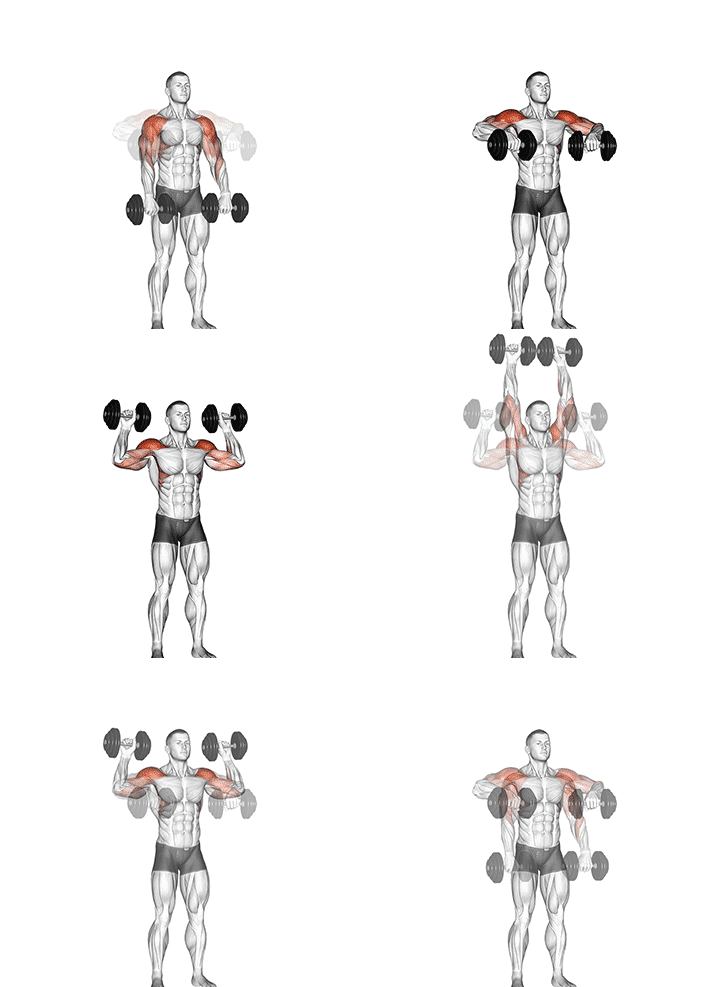
- 1. Stand with your feet shoulder-width apart, holding a dumbbell in each hand at shoulder level. Your palms should be facing down, and your elbows should be bent at a 90-degree angle.
- 2. Begin by lifting the dumbbells by performing an upright row. Keep your elbows pointed outward and close to your body as you raise the dumbbells toward your chin. Your palms should still be facing down.
- 3. Once the dumbbells reach chin height, rotate your wrists and forearms outward. This motion should resemble the movement of a "Cuban motion," where your elbows move higher than your hands.
- 4. Continue the motion by pressing the dumbbells upward until your arms are fully extended above your head. Your palms should now be facing forward.
- 5. Slowly reverse the movement. Rotate your wrists and forearms back inward, bringing the dumbbells down to chin height. Then, lower the dumbbells back to the starting position of the upright row.
- 6. Aim for 3-4 sets of 8-12 reps. Choose a weight that challenges you within this rep range, focusing on controlled and fluid movements.
Points to remember
- 1. Choose a weight that provides a challenge while permitting correct form, minimizing undue pressure on the shoulder joints.
- 2. Uphold a straight back and maintain proper posture to safeguard the spine from strain, facilitating effective muscle engagement.
- 3. Emphasize fluid wrist and forearm rotation during the "Cuban motion" to amplify shoulder mobility, promoting greater overall flexibility.
- 4. Begin with manageable weights, gradually increasing resistance over time to enhance proficiency and minimize the risk of potential injuries.
- 5. Perform the movement deliberately and with controlled tempo, preventing momentum and fostering optimal activation of the shoulder muscles.
Popular Questions
- Q1. Are the Cuban dumbbell press safe ?
- A1. Yes, the Cuban Dumbbell Press can be safe when performed with proper form and appropriate weights. Pay attention to controlled wrist rotation, warm-up adequately, and progress gradually to mitigate the risk of injury, ensuring a safe and effective shoulder exercise.
- Q2. What are the muscles worked by Cuban dumbbell press ?
- A2. The Cuban Dumbbell Press primarily engages the deltoid muscles, fostering shoulder strength and mobility. It also involves the triceps, upper back stabilizers, forearms, and core muscles, contributing to a well-rounded upper body workout.
- Q3. What are the best Cuban dumbbell press alternative ?
- A3. Effective alternatives to the Cuban Dumbbell Press include Lateral Raises for lateral deltoid focus, Arnold Press for rotational engagement, Front Raises for anterior deltoids, Push Press for compound strength, and Seated Shoulder Press for stability. Incorporate these variations for comprehensive shoulder development and a versatile upper body workout.
- Q4. What are the benefits of doing Cuban dumbbell press ?
- A4. The Cuban Dumbbell Press enhances shoulder muscle development and mobility by targeting all deltoid heads. It engages complementary muscles like triceps, upper back stabilizers, and core, contributing to overall upper body strength and functional fitness. Incorporating this exercise diversifies training, promoting balanced growth and improved shoulder health.