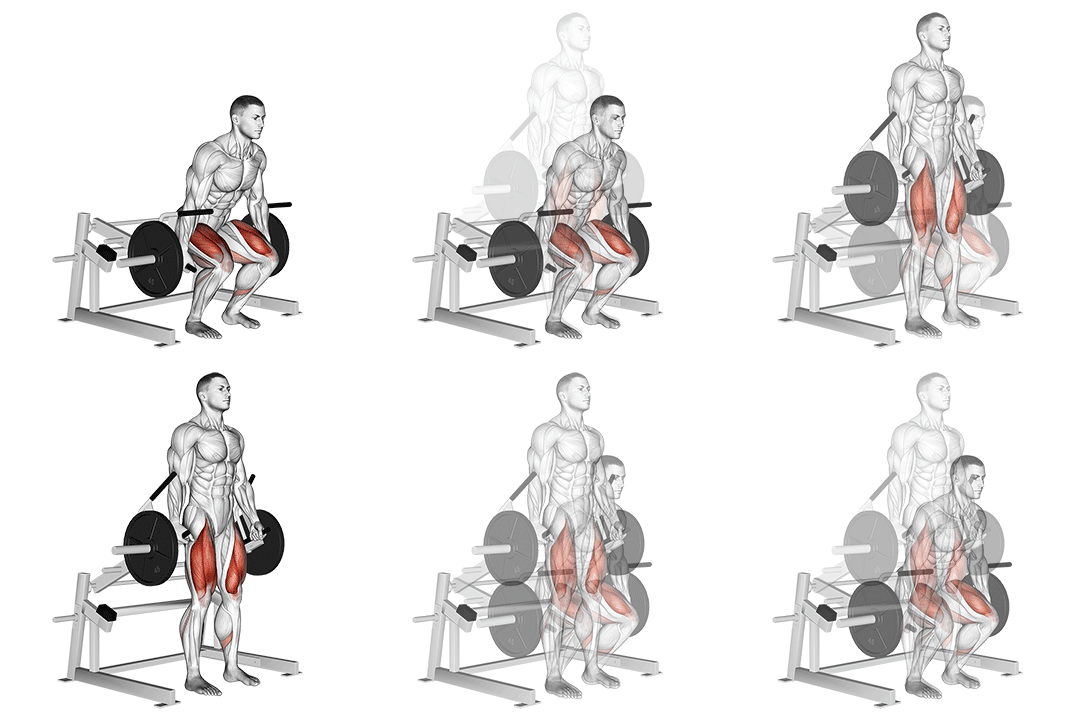
Target Muscle Group:
Quadriceps, Gluteus Maximus
Equipment Required
Lever Deadlift Machine
Experience Level:
Beginner
Secondary Muscles
Hamstrings, Rhomboids, Traps
Ideal sets & reps:
3 sets of 8 reps
Benefits
- 1. Maintaining balance during Lever Deadlifts necessitates significant core muscle engagement. This contributes to core strength and stability.
- 2. Since the motion simulates lifting objects from the ground, Lever Deadlifts enhance your ability to perform real-life lifting and carrying tasks safely and efficiently.
- 3. Lever Deadlifts engage multiple muscle groups, including the quadriceps, hamstrings, glutes, lower back, and traps. This compound movement promotes overall strength development.
- 4. Lever Deadlifts require proper lower back stabilization throughout the movement. This can help improve lower back strength and reduce the risk of injuries related to weak spinal erectors.
- 5. These deadlift variations place a significant emphasis on the quadriceps, helping to build size and strength in the front of the thighs. This is especially valuable for those aiming to develop well-rounded leg muscles.
Instructions
- 1. Place a lever or barbell with weight plates on the ground behind you, ensuring it's at an appropriate height.
- 2. Stand with your feet hip-width apart, toes slightly turned outward, and the barbell directly behind your heels.
- 3. Bend at your hips and knees to grip the barbell with both hands, just outside your knees, palms facing your body (pronated grip).
- 4. Stand up with the barbell, arms fully extended, and the barbell against your thighs. Keep your chest up, back straight, and shoulders pulled back and down.
- 5. Push your hips back and bend your knees slightly, lowering the barbell toward the floor while maintaining a straight back. Push through your heels to lift the barbell, extending your hips and knees.
- 6. Keep the barbell close to your body as you stand up. Then, reverse the movement to lower the barbell back to the floor. Perform the desired number of repetitions, maintaining proper form throughout. Focus on controlled movements.
Points to remember
- 1. Stand with your feet hip-width apart and toes slightly turned outward. This provides a stable base of support.
- 2. Keep your back straight with a natural arch in your lower back. Avoid rounding your back, as this can lead to injury.
- 3. Use a pronated (overhand) grip on the barbell, hands just outside your knees. Maintain a firm grip throughout the movement.
- 4. Initiate the movement by pushing your hips back while keeping your chest up. This engages your hip and leg muscles effectively.
- 5. Ensure the barbell is placed securely on the ground and that you have adequate space to perform the exercise without obstacles.
Popular Questions
- Q1. What are the benefits of doing lever deadlift ?
- A1. Lever deadlifts are highly effective for building overall strength, engaging multiple muscle groups in a functional manner. They also enhance core stability, promoting a strong and balanced physique while minimizing the risk of injuries.
- Q2. What are the best lever deadlift alternative's ?
- A2. Effective alternatives to lever deadlifts include traditional barbell deadlifts, trap bar deadlifts, Romanian deadlifts, sumo deadlifts, and hex bar deadlifts. These variations provide similar benefits for overall strength and muscle development while offering some variation in technique and muscle engagement.
- Q3. What are the muscles worked by lever deadlift ?
- A3. Lever deadlifts primarily engage the quadriceps, hamstrings, gluteus maximus, erector spinae, and calves. Secondary muscles involved include the adductors, triceps, forearm muscles, trapezius, rectus abdominis, and latissimus dorsi. These muscles work together to lift and stabilize the weight, making lever deadlifts an effective full-body exercise.