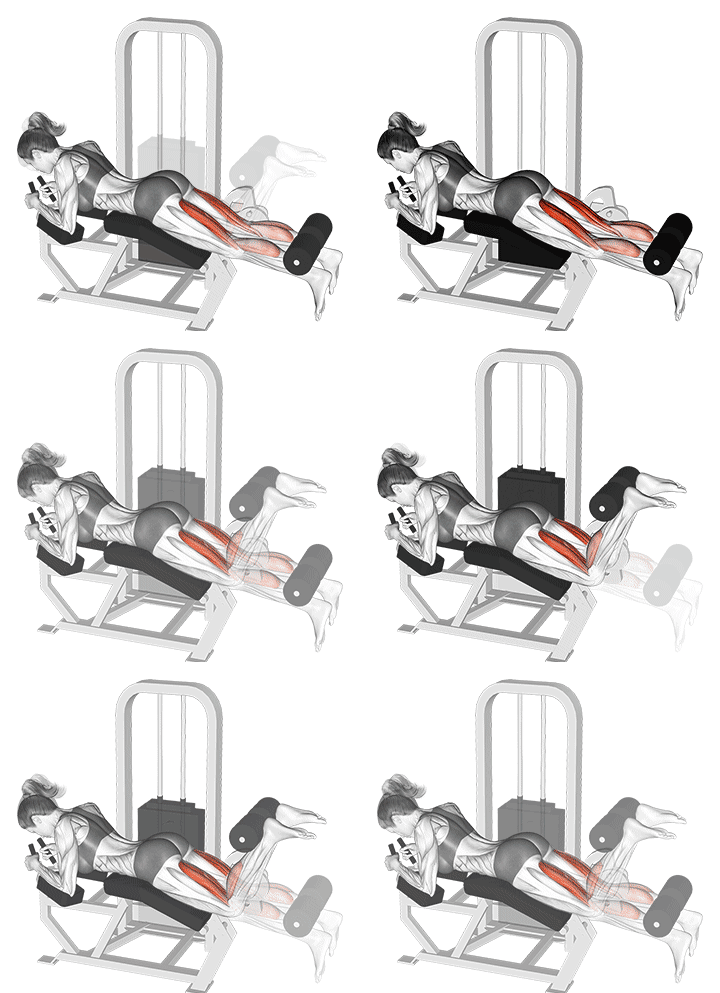
Target Muscle Group:
Hamstrings
Equipment Required
Leg curl Machine
Experience Level:
Beginner
Secondary Muscles
Calf muscles
Ideal sets & reps:
3 sets of 10 reps
Benefits
- 1. Leg curls can be performed using various equipment, such as machines, resistance bands, or even bodyweight exercises.
- 2. Improved muscle balance in the lower body can help prevent excessive pelvic tilt and lower back strain, promoting a more upright and stable posture.
- 3. Leg curls are one of the most effective exercises for isolating and strengthening the hamstrings. Well-developed hamstrings contribute to better overall leg symmetry and proportion.
- 4. Strengthening the hamstrings can help reduce the risk of common injuries, such as hamstring strains and ACL tears. These injuries often occur when there is an imbalance in muscle strength around the knee joint.
- 5. Strong hamstrings play a crucial role in various athletic activities, such as running, jumping, and change of direction. By strengthening your hamstrings, you can enhance your athletic performance and reduce the risk of injury.
Instructions
- 1. Adjust the machine to your body size. This includes setting the seat height and the lever arm position. Ensure that your knees are aligned with the machine's axis and that your ankles are positioned under the ankle pad.
- 2. Sit on the machine with your back pressed firmly against the backrest. Your hips and knees should be at a 90-degree angle. Your upper body should be straight, and your hands can grip the handles provided for stability..
- 3. Place the padded lever arm just above your ankles, resting on the back of your heels. Ensure your toes are pointed forward for proper hamstring engagement during leg curls.
- 4. While exhaling, contract your hamstrings by flexing your knees and pulling your heels toward your glutes. Focus on using your hamstrings to lift the weight. Your upper legs should remain in contact with the machine throughout the movement.
- 5. At the top of the movement, when your hamstrings are fully contracted, hold the position briefly to feel the squeeze for around 3-4 seconds. This is the peak of the exercise.
- 6. Inhale as you slowly extend your legs back to the starting position. Ensure a controlled and deliberate movement to avoid jerking or swinging. Keep your back firmly against the pad throughout the set.
- 7. Complete the desired number of repetitions. Aim for 3-4 sets of 10-12 repetitions, adjusting the weight as needed to challenge your muscles without sacrificing proper form.
Points to remember
- 1. Keep the motion slow and controlled throughout. Avoid using momentum or swinging the weight.
- 2. Use a weight that challenges your hamstrings but allows you to complete your desired sets with good form.
- 3. Focus on the eccentric (lowering) phase and the concentric (lifting) phase, ensuring both are deliberate and controlled.
- 4. Fully extend your legs and flex your knees to contract the hamstrings at the top of the movement, and avoid hyperextension at the bottom.
- 5. Maintain correct body alignment, with your back against the pad and your toes pointing forward. This ensures effective hamstring engagement.
Popular Questions
- Q1. What are the benefits of doing leg curls ?
- A1. Leg curls provide a range of benefits, with a primary focus on the hamstrings. By strengthening the hamstrings, leg curls enhance knee joint stability, which is crucial for injury prevention. Additionally, they contribute to balanced leg development, improving overall lower body strength and stability.
- Q2. What are the best leg curls alternative's ?
- A2. Alternatives to leg curls include pendulum squat, pin squat, and romanian deadlift. Pendulum squat emphasizes quad and hamstring development, pin squat engages hamstrings, quads, and glutes, while Romanian Deadlifts provide comprehensive lower body strength, targeting hamstrings, lower back, and glutes. These exercises offer variety in lower body workouts.
- Q3. What are the different variations of leg curls ?
- A3. Leg curls offer a variety of variations to target the hamstrings from different angles. The most common include lying leg curls (performed on a machine) mentioned above, seated leg curls, and standing leg curls (using resistance bands or a cable machine). Each variation provides unique benefits for hamstring development and can be tailored to individual preferences and fitness levels.
- Q4. What are the muscles worked by leg curls ?
- A4. Leg curls mainly work the hamstrings (biceps femoris, semitendinosus, and semimembranosus), group of muscles in the back of your thigh. These muscles bend your knee and help extend your hip. Leg curls also involve the calf muscles, specifically the gastrocnemius and soleus, which help stabilize your ankle during the exercise. So, leg curls are great for strengthening the back of your thigh and lower leg.